RapidDine
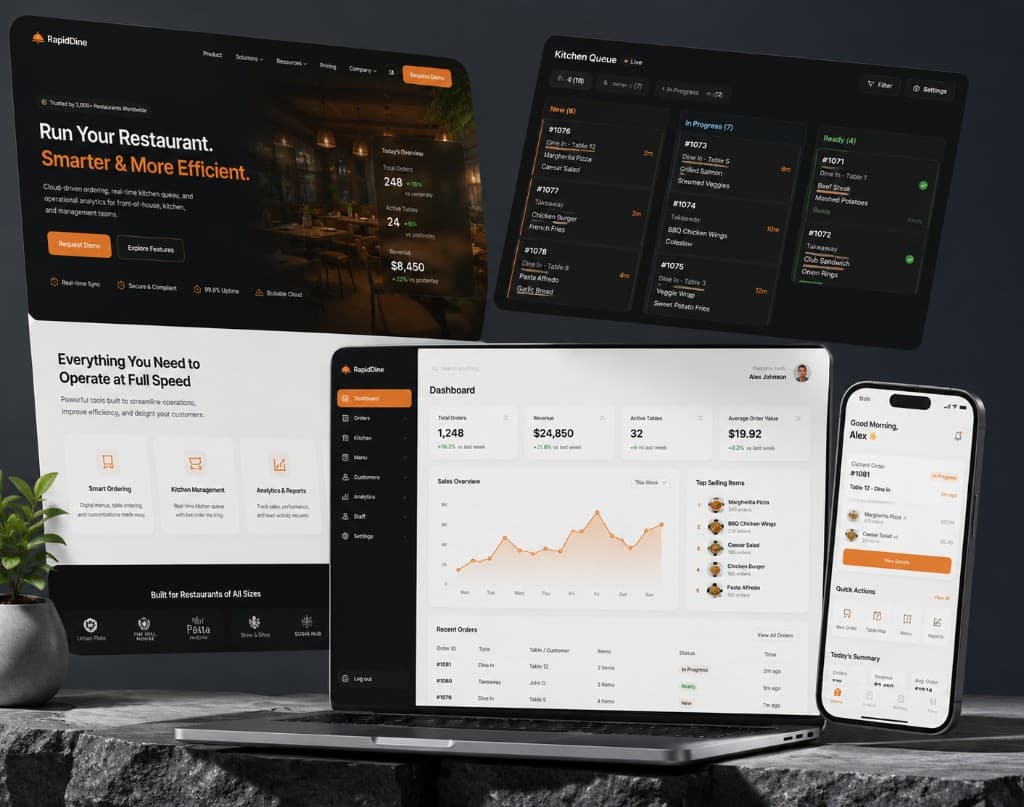
Cloud-driven restaurant ordering, real-time kitchen queue, and operational analytics for front-of-house, kitchen, and management teams.
Overview
Developed a robust operations platform for restaurants, combining a digital menu, order management, kitchen display systems, and staff accessibility tools. The system ensures real-time status visibility from order placement to service completion, empowering teams to deliver prompt, error-free service even under high demand.
Problem
Restaurants relying on paper tickets and scattered digital tools struggle with miscommunication, order delays, and operational bottlenecks, particularly during busy shifts. Lack of real-time coordination causes kitchen confusion, lost orders, and inefficient reporting, impacting both service quality and business insights.
Solution
Engineered a centralized web application that digitally manages menu offerings, routes live orders to appropriate kitchen stations using WebSockets, and maintains a synchronized view of active and historical orders for staff and managers. All roles—admin, kitchen, counter—operate from unified, role-specific dashboards tightly integrated with data persistence and analytics.
Features
- Interactive digital menu with category, modifier, and availability controls
- Instant order placement and live kitchen order queue with preparation timers
- Role-based dashboards for counter, kitchen, and admin functions
- Comprehensive order status management (placed → in progress → served)
- Sales, performance, and inventory analytics reporting
- Centralized menu management and dynamic pricing
- Real-time kitchen and counter synchronization using Socket.io
- Mobile-optimized interface for staff across devices
Architecture
Frontend Experience
React.js SPA architected with modular UI components, stateful order flows, and mobile-first design for staff accessibility.
Realtime Order Flow
Socket.io-powered bidirectional communication syncing order and status events between counter and multiple kitchen stations.
Backend & Persistence
Node.js REST API services with MongoDB for flexible menu document structures, order/event logs, and analytics aggregation.
Access Control
Role-based authentication with granular permissions for admin, kitchen, and front-of-house users.
Challenges
- Ensuring atomicity and real-time consistency of order state across concurrent kitchen and counter interactions
- Designing kitchen and counter UIs for ultra-fast, glanceable operation in noisy, high-traffic environments
- Building robust role separation and audit trails to track order assignment, progression, and modifications
- Handling dynamic menu changes and out-of-stock events during service without disrupting active orders
- Optimizing event-driven WebSocket workflow to minimize latency and support multiple simultaneous connections
Outcomes
- →Eliminated manual miscommunication between service and kitchen teams, reducing order delays and preparation errors
- →Enabled instant, transparent tracking of all orders through preparation and service lifecycles
- →Provided actionable analytics and order history for management, supporting business planning and performance optimization
- →Created an extensible platform architecture ready for integration with POS, payment, and inventory systems
- →Drove measurable improvements in staff coordination and customer turnaround time during high-traffic periods
Learnings
- Effective real-time systems in hospitality require explicit, well-typed state machines rather than loose event triggers
- Glanceable, low-distraction UX for staff dramatically improves speed and accuracy in high-pressure environments
- Operational resilience depends on robust order recovery, persistent audit logs, and granular permissions control
- Coordinating across multiple user types (admin, staff, kitchen) demands clear, role-specific workflow isolation
Next project
Kameti Ledger