Kameti Ledger
Desktop-based financial ledger and chit fund management system with advanced payment tracking, auditability, and flexible installment handling.
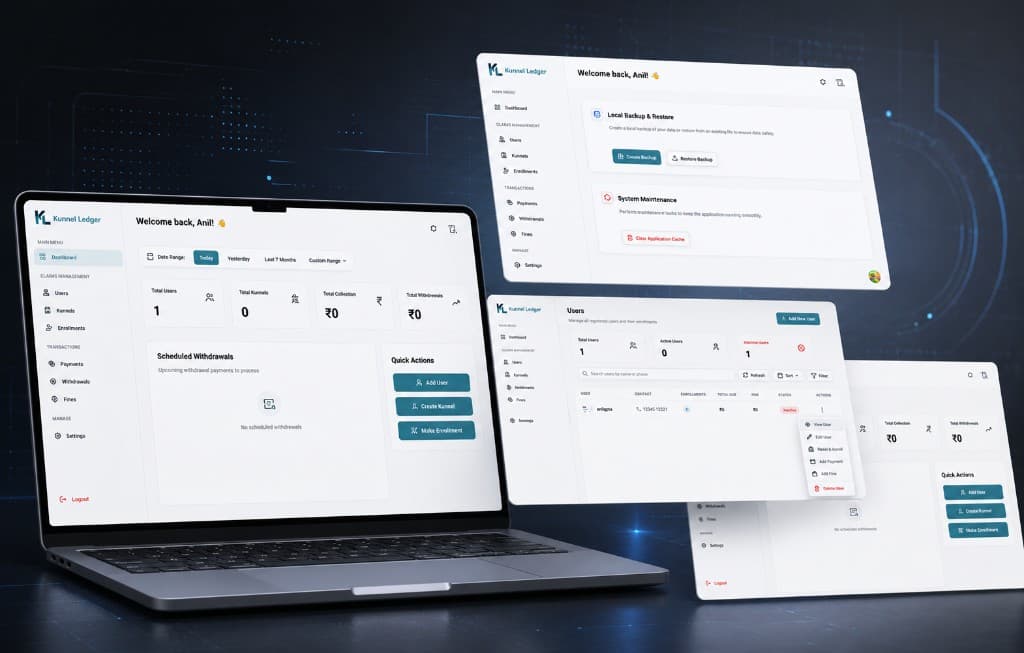
Overview
Architected and developed a desktop-first financial ledger platform for managing Kametis with advanced installment workflows, flexible payment adjustments, withdrawal management, and fully explainable financial calculations.
Problem
Traditional Kameti operations are often managed manually through notebooks, spreadsheets, and fragmented records, leading to calculation mistakes, missing payment history, poor visibility into dues, and zero auditability for financial decisions.
Solution
Designed a modular financial management system with event-driven payment tracking, multi-entry installment support, withdrawal workflows, calculation logs, and real-time reporting to handle complex real-world Kameti operations with transparency and reliability.
Features
- Multi-kameti financial management system
- Advanced installment tracking with partial and extra payment handling
- Flexible adjustment engine for future installment settlements
- Monthly withdrawal workflows with custom month-wise payout rules
- Joint enrollment and multi-user participation support
- Financial audit logs with explainable calculation breakdowns
- Interactive dashboards with payment and progress analytics
- Document uploads for KYC and agreement management
- Keyboard-optimized desktop workflows for rapid data entry
- Cross-module reporting for users, enrollments, dues, and withdrawals
Architecture
Desktop Shell
Electron-based desktop runtime with isolated IPC communication and secure native integrations.
Frontend Layer
React + TypeScript application with modular feature architecture, centralized state management, and reusable UI systems.
Domain Engine
Dedicated financial logic layer handling installments, dues, fines, extra adjustments, withdrawals, and audit calculations independently from UI.
Persistence Layer
SQL-driven relational data architecture optimized for transactional consistency, financial traceability, and reporting performance.
Challenges
- Designing a flexible installment engine capable of handling partial, skipped, extra, and late payments without corrupting financial state
- Building explainable financial calculations with audit trails for every automated adjustment
- Managing complex enrollment relationships including multiple enrollments and joint participation scenarios
- Separating business logic from Electron and UI layers for future web/mobile scalability
- Designing high-speed UX workflows for operators handling large daily financial entries
Outcomes
- →Replaced fragmented manual bookkeeping workflows with centralized digital financial tracking
- →Improved visibility into user dues, payments, and withdrawal activity across multiple Kametis
- →Created scalable architecture capable of expanding into web and mobile platforms
- →Established reusable financial domain modules for future fintech-oriented applications
Learnings
- Financial systems should be modeled around immutable events and auditability rather than mutable balances
- Desktop applications handling operational workflows require extremely optimized navigation and low-friction data entry
- Complex payment systems become maintainable only when domain logic is isolated from UI and storage layers
- Explainability of calculations is as important as the calculations themselves in financial products
Next project
Event-Driven Notification & Analytics Platform