Event-Driven Notification & Analytics Platform
Distributed serverless event processing platform with fan-out notifications and analytics pipelines.
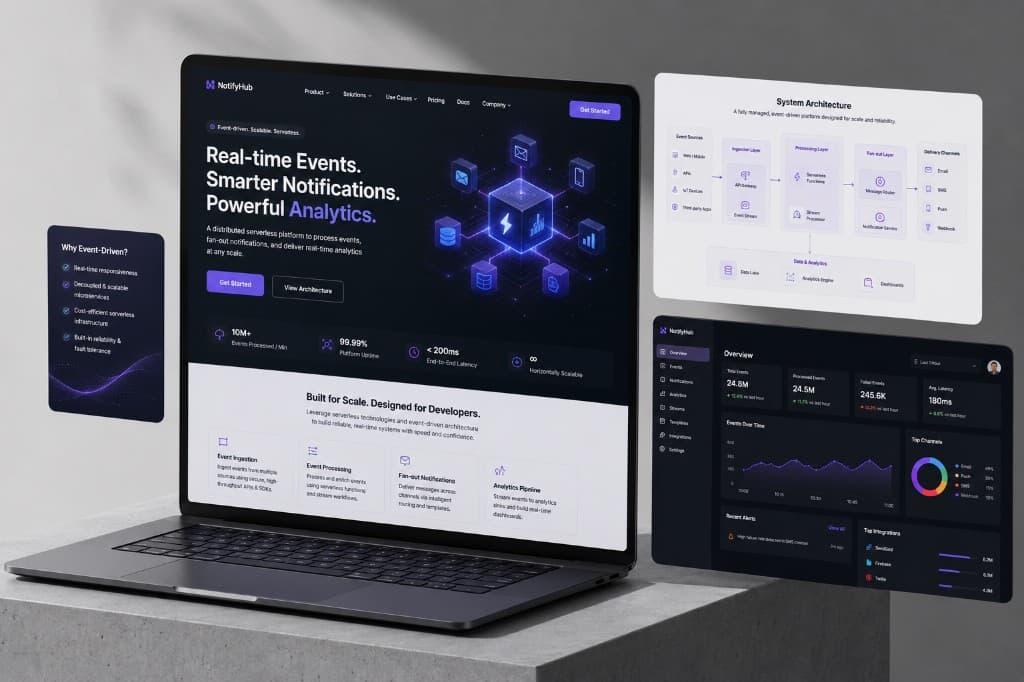
Overview
Designed a serverless event-driven platform capable of processing and routing application events to multiple independent consumers with retry handling, dead-letter queues, structured logging, and asynchronous fan-out architecture.
Problem
Core application services were tightly coupled with notification and analytics workflows, creating reliability bottlenecks, blocking synchronous operations, and increasing operational complexity as event volume scaled.
Solution
Implemented an event-driven architecture using Amazon EventBridge as the central event bus, Lambda-based consumers for isolated processing, and SQS-backed retry mechanisms with DLQ support to ensure fault-tolerant and scalable event handling.
Features
- Centralized event bus for decoupled inter-service communication
- Multi-consumer fan-out architecture for notifications, analytics, and audit logging
- Idempotent event processing to prevent duplicate execution during retries
- Dead-letter queue strategy for failed event isolation and replay
- Structured logging and monitoring with CloudWatch
- Serverless CI/CD pipeline using GitHub Actions and AWS IAM OIDC authentication
- Asynchronous event processing with automatic scaling under load
- Environment-aware infrastructure deployment using Serverless Framework
Architecture
Event Ingestion
REST APIs publish domain events to Amazon EventBridge through Lambda-based publisher services.
Event Routing
EventBridge rules route events dynamically to independent Lambda consumers based on event type and source patterns.
Asynchronous Processing
Dedicated Lambda consumers process notifications, analytics persistence, and audit logging workflows independently.
Failure Handling
SQS dead-letter queues capture repeatedly failed events for inspection, replay, and operational recovery.
Challenges
- Designing idempotent consumers to safely handle duplicate event deliveries
- Managing retry behavior and visibility timeouts in asynchronous workflows
- Preventing tight coupling between event producers and downstream consumers
- Handling Lambda cold starts and execution timeout alignment
- Ensuring fault isolation without impacting unrelated consumers
Outcomes
- →Established a loosely coupled event-driven architecture improving scalability and maintainability
- →Reduced dependency between core business workflows and notification infrastructure
- →Enabled independent scaling and deployment of downstream processing services
- →Improved operational resilience through DLQ-based failure recovery mechanisms
- →Created reusable serverless infrastructure patterns for future distributed systems
Learnings
- Event-driven systems require strong idempotency and retry-awareness by design
- Serverless architectures are highly effective for bursty asynchronous workloads
- Distributed systems demand explicit failure handling and observability strategies
- EventBridge simplifies scalable fan-out architectures compared to tightly coupled service integrations
- Infrastructure-as-Code and CI/CD are critical for repeatable cloud deployments
Next project
TypoLens